Light RODI operational intelligence visualization for fashion flow, industry optimization, and smart trade AI

Research initiative

Real-Time On-Demand Intelligence

Mission-critical operational intelligence for real-time enterprise decisions where accuracy, reliability, and explainability matter.

Mission-critical intelligence

From reliable theory to commercializable operational AI.

RODI is designed for mission-critical operational intelligence, where decisions must be accurate, reliable, and explainable. In high-impact enterprise and infrastructure applications, AI systems cannot rely on plausible but uncertain outputs, and hallucination is not acceptable.

Our mission is to build a new class of real-time, on-demand intelligence systems that combine the flexibility of modern AI with the reliability required for real-world operations.

Vision

Trustworthy Operational Intelligence

The vision of RODI is to move beyond general-purpose AI assistants toward systems that can reason, verify, adapt, and support decisions in complex environments such as supply chains, industrial planning, transportation, trade services, and production workflows.

Research Foundation

Reasoning Under Uncertainty

RODI brings together large language models, formal systems, causal inference, non-monotonic logic, and category-theoretic perspectives to study how intelligent systems can reason under uncertainty while still maintaining correctness.

Real-World Applications

Deployable Intelligence Across Domains

RODI connects LLM-driven interaction, structured workflows, formal verification, causal models, and real-time operational data to support decisions that can be acted on in practice. Current examples include Fashion Flow, Industry Optimization, and Smart Trade AI, and we welcome collaboration with partners who want to apply RODI technologies in other mission-critical domains.

System architecture

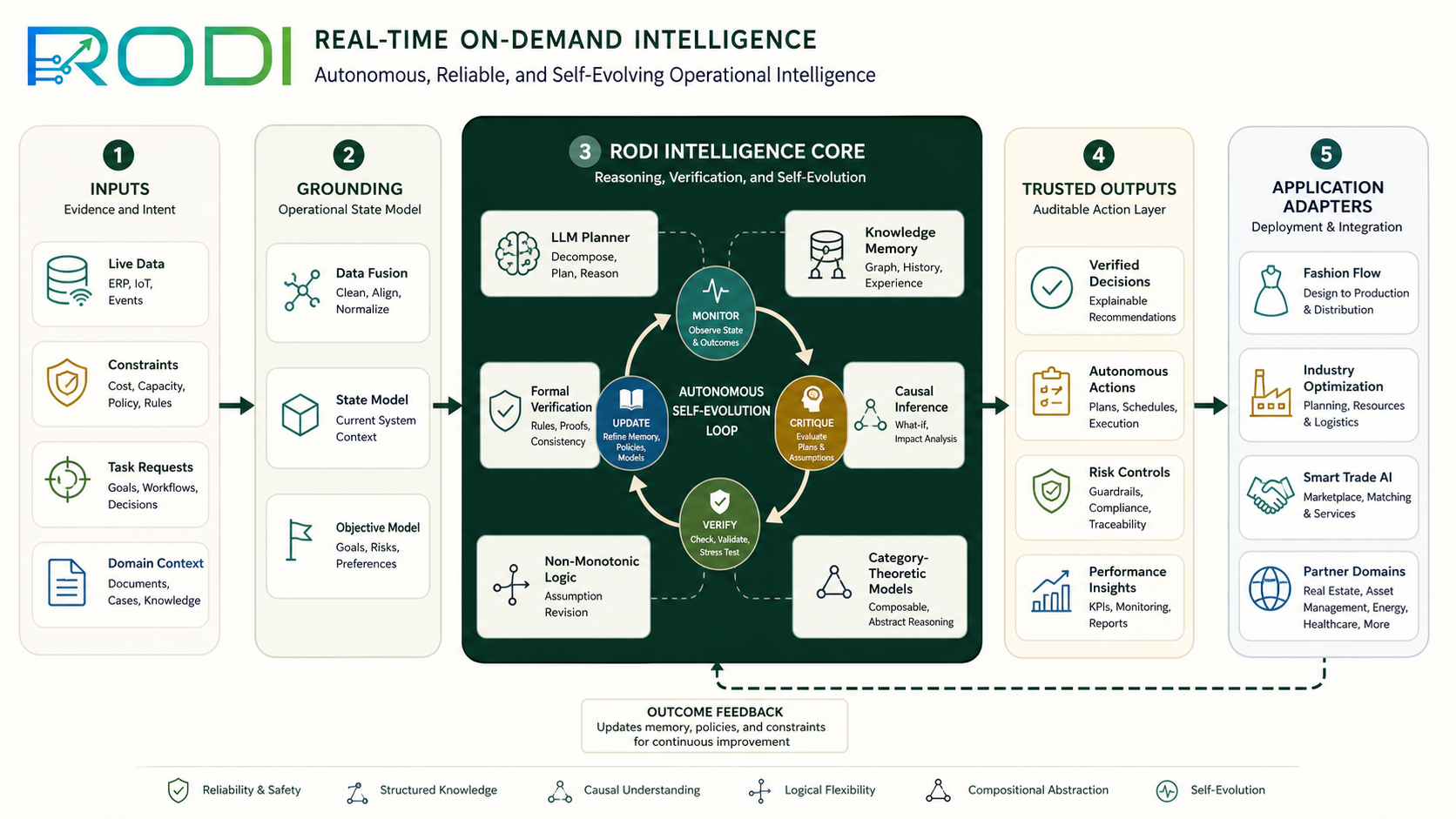
Technical view of RODI operational intelligence.

The RODI system connects real-time enterprise data, operational constraints, and task requests with grounded state modeling, LLM-based planning, structured knowledge, formal verification, causal inference, non-monotonic logic, category-theoretic abstractions, and an internal self-evolution loop to produce reliable decision support and deployable application adapters.

RODI technical architecture diagram

Demos

Demos and project materials

01

Fashion Flow

Fashion Flow connects fashion design intelligence with real production execution. It supports clothing design suggestions, trend-aware product concepts, and the coordination of factories, garment resources, capacity, production, and distribution as a product-ready AI workflow for the fashion industry.

Video
02

Competitor Analysis

Competitor Analysis is a project for comprehensive market analysis that draws on multi-source information—web research, platform data, product signals, and structured reporting—to map competitive landscapes, compare offerings, and support strategic decisions with evidence-backed insights.

Open demo
03

Industry Optimization

Industry Optimization focuses on AI-supported industrial and transportation optimization, improving resource allocation, production coordination, logistics decisions, transportation workflows, and real-time enterprise operations for deployable commercial and industrial applications.

04

Smart Trade AI

Smart Trade AI is an AI-powered marketplace framework for skilled trade businesses, using LLMs, task templates, quotation intelligence, matching, scheduling, compliance checks, and feedback learning to support a commercially viable trade-service platform.

Read document
05

Future Domain Collaboration

RODI can be adapted to additional domains such as real estate, asset management, infrastructure services, enterprise operations, and other settings where reliable real-time intelligence can improve decisions, workflows, and commercial outcomes.

Discuss collaboration

Members

Research team

Our team brings together research backgrounds in adaptive reasoning, privacy-preserving AI, sustainable infrastructure, enterprise modeling, and intelligent operational systems.

JW

Dr. Jie Wang

Principal Investigator

Dr. Jie Wang is the Executive Director of the Stanford Center for Sustainable Development and Global Competitiveness. His research spans adaptive computational learning, enterprise modeling, sustainable development, smart infrastructure, knowledge systems, decision frameworks, smart manufacturing, and business innovation. He has conducted research at Stanford, advised Silicon Valley startups, consulted for multinational companies and government agencies, and served as a senior advisor to venture-backed startups.

JG

Dr. Jiechao Gao

Postdoctoral Researcher

Dr. Jiechao Gao received his Ph.D. in Computer Science from the University of Virginia and M.S. in Electrical Engineering from Columbia University, and previously served as an Associate Research Scientist at Columbia University. His research spans federated learning, LLM interpretability and efficiency, reinforcement learning, and privacy-preserving AI, with applications in healthcare, smart buildings, IoV, and finance. He has published at major venues including ICLR, NeurIPS, ICML, AAAI, EMNLP, KDD, CVPR, and ACL, and was named a Stanford/Elsevier Global Top 2% Scientist in 2024 and 2025.

YP

Dr. Yuandong Pan

Postdoctoral Researcher

Dr. Yuandong Pan is a Postdoctoral Researcher in Stanford School of Engineering and was previously a Marie Sklodowska-Curie Actions Future Road Research Fellow at the University of Cambridge. His research develops digital and smart approaches for sustainable buildings, infrastructure, and cities, improving how the built environment is designed, managed, and maintained to support smarter, more resilient, and more sustainable urban systems.

Publications

Research papers

Selected publications from 2023 onward, with RODI team members highlighted in the author lists.

2026

LLM-enabled multi-agent framework for automated Scan-to-BIM and Scan-to-Graph reconstruction

Yuandong Pan, M Wang, Jiechao Gao, Jie Wang, MD Lepech, I Brilakis

Automation in Construction

LLM-Guided Semantic Bootstrapping for Interpretable Text Classification with Tsetlin Machines

Jiechao Gao, RK Yadav, Y Li, Yuandong Pan, Jie Wang, Y Liu, M Lepech

ACL 2026

LLM-enabled multi-agent framework for natural language interaction with graph-based digital twins

Yuandong Pan, M Wang, L Lu, R Lamsal, E Parn, S Zlatanova, I Brilakis

Automation in Construction

Data Sharing Mechanism among Intelligent Transportation Infrastructure Stakeholders: Based on the Data Value Chain Perspective

J Liu, T Jin, Yuandong Pan, Y Li

Journal of Construction Engineering and Management

A Digital Twin-Based Approach for Dynamic Traffic-Aware Routing and Charging of Electric Vehicles

Y Xie, S Li, L Lu, Yuandong Pan, F Iida

Expert Systems with Applications

Perceiving Creativity in the Age of AI: How Labels, Beliefs, and Familiarity Shape Evaluations of AI-Generated and Human-Created Art

D Koo, Jiechao Gao, Yuandong Pan, Jie Wang, M Lepech

SocialLLM@ICWSM 2026

Trustworthy Agent Network: Trust in Agent Networks Must Be Baked In, Not Bolted On

Y Yao, Y Yao, X Fan, Jiechao Gao, Jie Wang, M Zhang, S Ravi, C Joe-Wong

KDD Blue Sky Track 2026

Deterministic Component Mining for Multi-framework UI2Code Generation

Zixiong Yang, Linxiao Li, Jiaye Lin, Binrui Wu, Xiaoyu Kang, Jiechao Gao

ICML 2026

MulFCoder: Framework-conditioned Multi-agent for MLLM-based Multi-framework Front-end Code Generation

Jie Wu, Haoran Ma, Shisong Tang, Yulin Xu, Xiaoyu Kang, Jiechao Gao

ICML 2026

GRO-RAG: Gradient-aware Re-rank Optimization for Multi-source Retrieval-Augmented Generation

Siyuan Chen, Ding Hang, Xiaoyu Kang, Jiechao Gao

ICLR 2026

S2D-ALIGN: Shallow-to-Deep Auxiliary Learning for Anatomically-Grounded Radiology Report Generation

Jiechao Gao, C Liu, Y Li

AAAI 2026

Mitigating hallucinations in large language models via causal reasoning

Y Li, Y Shen, Y Nian, Jiechao Gao, Z Wang, C Yu, S Li, Jie Wang, X Hu, Y Zhao

AAAI 2026

Are Large Language Models Economically Viable for Industry Deployment?

Abdullah Mohammad, Sushant Kumar Ray, Pushkar Arora, Rafiq Ali, Ebad Shabbir, Gautam Siddharth Kashyap, Jiechao Gao, Usman Naseem

ACL Industry Track 2026

2025

Enhancing Interpretability in Self-Training with Tsetlin Machines for Mitigating Noisy Pseudo-Labels

Jiechao Gao, RK Yadav, X Huang, Jie Wang

IEEE BigData 2025

Federated Neural Architecture Search with Model-Agnostic Meta Learning

X Huang, Jiechao Gao, Jie Wang

IEEE BigData 2025

MPF: A Multi-Noise Perception Framework to Enhance Online Map Matching Algorithms

Hanwen Hu, Cheng Zeng, Shiyou Qian, Jianhua Zhou, Jian Cao, Yirong Chen, Jie Wang, Han Han

IEEE T-ITS 2025

Modeling heterogeneous spatiotemporal pavement data for condition prediction and preventive maintenance in digital twin-enabled highway management

L Lu, AM d'Avigneau, Yuandong Pan, Z Sun, P Luo, I Brilakis

Automation in Construction

Zero-Shot Learning with Vision-Language Models for Estimating Building Energy Efficiency from Street View Images

Yuandong Pan, L Lu, M Wang, VK Reja, F Noichl, A Borrmann, I Brilakis

Computing in Civil Engineering 2025

Antecedents to Moving Forward: Impact of Multiple Stakeholder Relationship Networks on Operational Resilience in Cross-Border Critical Infrastructure Systems

T Wang, J Liu, Yuandong Pan, H Li

Journal of Management in Engineering

Impact of color and mixing proportion of synthetic point clouds on semantic segmentation

S Zhou, JR Lin, P Pan, Yuandong Pan, I Brilakis

Automation in Construction

Standard Market Environments for Financial Reinforcement Learning

C Feng, L Huang, K Wang, Y Cao, M Zhu, Jiechao Gao, XY Liu

NeurIPS Workshop 2025

Adaptive Gradient Masking for Balancing ID and MLLM-based Representations in Recommendation

Y Wu, S Chen, B Wu, F Li, Jiechao Gao

NeurIPS 2025

Calibrating Video Watch-time Predictions with Credible Prototype Alignment

C Cui, S Tang, F Li, Jiechao Gao, H Chen

ICML 2025

Aligning and Balancing ID and Multimodal Representations for Recommendation

B Wu, S Tang, F Li, B Han, C Meng, J Xiao, Jiechao Gao

KDD 2025

Prototype-Guided Representation Projection for Multi-Domain Multi-Task Recommendation

B Wu, H Sui, J Lin, Jiechao Gao, T Xu, K Jin, X Zhang

ACM MM 2025

2024

Scan-to-graph: Automatic generation and representation of highway geometric digital twins from point cloud data

Yuandong Pan, M Wang, L Lu, R Wei, S Cavazzi, M Peck, I Brilakis

Automation in Construction

Towards Trustworthy Road Digital Twins: A State-of-the-Art Review

L Lu, Yuandong Pan, I Brilakis

Computing in Civil Engineering 2024

Differentially Private Low-Rank Adaptation of Large Language Model Using Federated Learning

XY Liu, R Zhu, D Zha, Jiechao Gao, S Zhong, M Qiu

ACM TMIS 2024

2023

AMM: An Adaptive Online Map Matching Algorithm

Hanwen Hu, Shiyou Qian, Jingchao Ouyang, Jian Cao, Han Han, Jie Wang, Yirong Chen

IEEE T-ITS 2023

3D deep-learning-enhanced void-growing approach in creating geometric digital twins of buildings

Yuandong Pan, A Braun, A Borrmann, I Brilakis

Smart Infrastructure and Construction

Pfdrl: Personalized federated deep reinforcement learning for residential energy management

Jiechao Gao, W Wang, F Nikseresht, V Govinda Rajan, B Campbell

ICPP 2023

Contact

Interested in collaborating?

Contact the RODI team to discuss research collaboration, demos, project documents, or enterprise operational intelligence applications.